Donate
 Contact Us

 Careers
 Pay a Bill
 Schedule
 MyChart
 Donate
 Contact Us
Essentia’s blood pressure home monitoring program likely to 'end up saving lives’
May 04, 2026 By: Louie St. George
For years, medical professionals have struggled to get consistent and accurate blood pressure readings from patients. Those readings, crucial to inform effective treatment plans, have required patients to make an appointment, perhaps take time off work and travel to their nearest clinic.
And that still doesn’t guarantee accuracy. Environmental factors — driving through a snow storm, inherent stress of going to the doctor — can artificially inflate a person’s blood pressure.
At Essentia Health, rather than simply noting a high blood pressure reading and sending patients home with advice, many individuals are enrolled in a MyChart-based program and supplied with a Bluetooth-enabled blood pressure cuff. They also receive access to educational resources and a safety net that helps detect potential problems before they become emergencies.
Essentia’s 12-week blood pressure home monitoring program is for patients with uncomplicated hypertension (another word for high blood pressure). Essentia has enrolled hundreds of patients since the program’s inception in April 2025.
Here’s how it works: Patients take their blood pressure at home. The readings flow into Essentia’s electronic medical record, Epic. If a reading exceeds a predetermined threshold, an alert is triggered and routed to the nurse care line team. A nurse reaches out to the patient to assess symptoms, reinforce education and, if needed, assist the patient with adjusting their medication doses. Occasionally, the patient may be referred to a pharmacist to discuss their medications and explore additional options for reaching their blood pressure goals.
What exactly is blood pressure?
Two numbers are used to measure the force of blood against artery walls. Those two numbers, according to the American Heart Association (AHA), are:
Systolic blood pressure is the first (top/upper) number. It measures the pressure your blood is pushing against your artery walls when the heart beats.
Diastolic blood pressure is the second (bottom/lower) number. It measures the pressure your blood is pushing against your artery walls while the heart muscle rests between beats.
Why it matters
Hypertension can lead to serious health concerns, including heart attack, heart failure, stroke, kidney disease, kidney failure and vision loss, among others.
Making it easier for at-risk patients to monitor their blood pressure isn’t just smart preventive care; it’s potentially lifesaving. It’s especially beneficial for patients who live in small, isolated communities and don’t have immediate access to a medical provider. About 84% of Essentia’s service area is classified as rural.
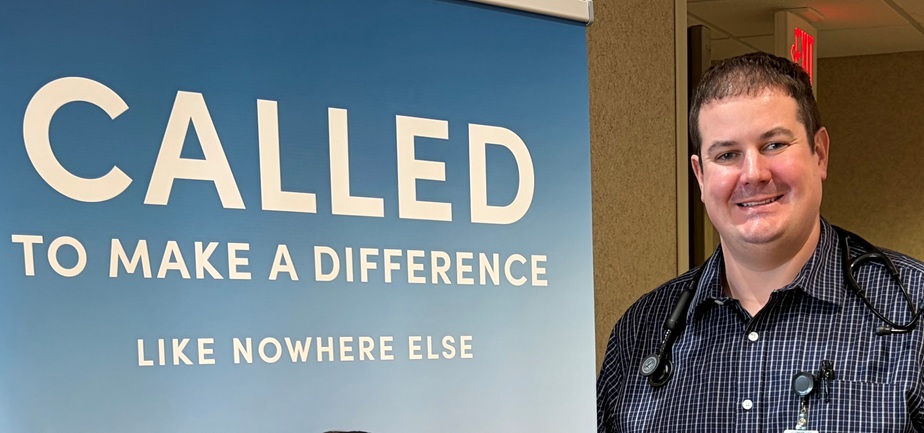
“That’s exactly what I designed this program for,” says Dr. Michael Sterns, a family medicine physician at Essentia Health in Superior who helped bring the program to life. “We serve a very rural population. For some of my patients, it can be an hour or an hour-and-a-half drive just to get their blood pressure taken. Those are roadblocks.”
Removing those roadblocks makes health care more accessible, improving health outcomes.
“Ultimately, I think this is work that will end up saving lives,” Dr. Sterns says. “If we can help prevent someone from having a heart attack or stroke, that would be amazing, because that’s someone’s mom, dad, brother, sister. Nobody wants to see a loved one go through that.”
Patient success
Tom Nigbor admits he likely wouldn’t have kept close tabs on his blood pressure without the benefit of technology and Essentia’s program.
“It’s a half-hour drive to my clinic, so that would not have happened without this home monitoring program,” says the 65-year-old resident of Grand View, Wisconsin, about 25 miles south of Ashland.
The retired physician assistant had previously purchased his own cuff, which syncs to an app on his phone. He transfers the readings from the app to MyChart, where it’s tracked by Essentia nurses, and is also prompted to list any symptoms he may be experiencing. A nurse alerts him and his primary care provider — Dana Covey of the Essentia Health-Ashland Clinic — if anything is amiss.
So far, so good.
Nigbor’s blood pressure has dropped from 200/100, considered severe and a potential hypertensive emergency, to 130/80, which is close to the normal range.
“It was pretty crazy there for a while,” he says before noting the ease of home monitoring through Essentia. “It’s a really seamless, thorough process.”
By the numbers
About 900 Essentia patients have been enrolled in the program over the past year. Half of them were engaged, or active participants, in the program. Among engaged patients, 84% attained their target blood pressure, far better than the initial goal of 70%.
Nearly 700 blood pressure cuffs were supplied to patients, who keep them even after they’ve completed the program.
Upon completion, participants were surveyed about their experience:
• 77% felt the time they spent on the program was worthwhile.
• 75% were satisfied or very satisfied with the care they received.
• 64% made changes to their lifestyle based on what they learned in the program.
Symptoms of elevated blood pressure include chest pain, shortness of breath, back pain, numbness, weakness, change in vision and difficulty speaking.